
Rockwool R30 insulation is 7.25 inches thick. That’s the exact depth of a 2×8 joist or rafter, so it fills that space without squeezing. The batts come 15.25 inches wide for framing 16 inches apart and 23 inches wide for framing 24 inches apart, and each is 47 inches long. It fits best in 2×8 …
More
How Thick Rockwool R30 Insulation Is for Your Home

How Many Bags of Cellulose Insulation Your Attic Needs
To find how many bags of cellulose insulation your attic needs, divide your attic floor area by the coverage per bag for your target R-value. That coverage is printed on the bag chart. For one common 30-pound cellulose product, R-49 covers about 16.5 square feet per bag. That’s about 60 bags per 1,000 square feet, …
More
Why Commercial Buildings Use Foamglas Cellular Glass Insulation
Commercial buildings use Foamglas cellular glass insulation where ordinary foam boards fall short. It’s made of glass blown into tiny sealed bubbles, so it won’t burn, won’t soak up water and blocks water vapor completely. It’s also strong enough to sit under concrete slabs and heavy roof decks. The trade-off is a modest R-value, about …
More
The Best Insulation for Garage Walls in Attached vs Detached Garages
For an attached garage, the best insulation goes on the wall you share with the house. Use fiberglass or mineral wool batts, seal every gap so car fumes stay out, and cover the garage side with drywall as the fire code requires. The outside garage walls only matter if you heat the space. For a …
More
How to Use a Wall Insulation Calculator for Your Home
A wall insulation calculator does three simple things. It finds the total area of your outside walls, subtracts the windows and doors, then divides what’s left by how much one bag covers. For batts, the coverage is printed on the bag. For dense-pack cellulose in a 2×4 wall, plan on roughly three-quarters of a pound …
More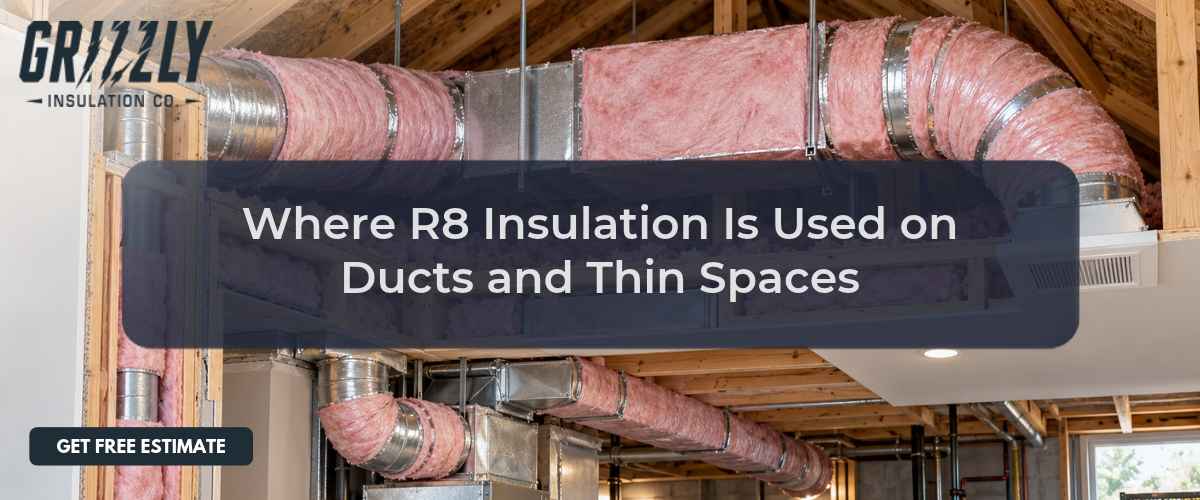
Where R8 Insulation Is Used on Ducts and Thin Spaces
R8 insulation is used mainly on heating and cooling ducts. The residential code requires R-8 on supply and return ducts that run through an attic, as long as they’re 3 inches across or bigger. That’s why most flex duct and duct wrap is sold as R-8. You’ll also find R8 in thin spots where thick …
More
Why Polyisocyanurate Insulation Loses R-Value in Cold Colorado Winters
Polyisocyanurate insulation, or polyiso, is rated around R-6 per inch at room temperature. When the board itself gets colder than about freezing, it loses some of that R-value. The gas trapped in its cells starts to condense and carries heat more easily. In cold places like Colorado, roofing pros plan around R-5 per inch instead …
More
Does Double Bubble Insulation Really Work on Metal Buildings
Double bubble insulation does work on metal buildings, but only in a narrow way. It needs an open air gap next to its foil face, and its main jobs are blocking summer sun heat and stopping condensation from dripping off the steel. Pressed flat against metal with no air space, it adds very little R-value. …
More
Why Open Cell Spray Foam Insulation Can’t Go Into Existing Closed Walls
The open cell spray foam you see sprayed into new walls can’t go into a wall that already has drywall on it. It comes out of a spray gun, expands about 100 times in seconds, and has to be laid on in passes that the installer can see. Inside a closed wall, nobody can see …
More