
Denver Insulation › Spray Foam Insulation
Spray Foam Insulation in Denver, CO
Closed-cell spray foam insulates and air-seals in one pass — R-6.5+ per inch and a monolithic barrier the Front Range wind can’t push through. It’s the right call for Denver’s rim joists, additions, and the tight, complex framing of Baker’s older homes.
- Free on-site foam assessment
- Board-foot pricing in writing
- Certified installers, zero mess
Your local crew, 10 miles away
Commerce City HQ · all 5 Denver ZIPs
How hard does your insulation work per inch?
R-value per inch decides how much protection fits inside tight framing. Here’s how common materials compare — and why foam wins where space is short in a Denver home:
- Manufacturer-rated values. Your assessment shows exactly where foam earns its premium in your home, and where it doesn't.
TRUSTED PRODUCTS & PARTNERS
The Brands Behind Every Grizzly Install
We don’t install mystery material. Every Denver project uses products from the industry’s most trusted manufacturers.








01THE PROBLEM
Insulation Slows Heat. Only an Air Barrier Stops the Wind.
Front Range wind off the foothills pressure-tests Denver homes, and Victorian-era brick homes and bungalows leak air through walls that were never sealed. Fibrous insulation slows heat but never stops air movement; closed-cell foam creates a continuous air barrier — the right fix for the leakiest assemblies.
ARim joists bleeding heat at the foundation
The rim joist — where your house meets its foundation — is the leakiest lumber in the building, and in Denver’s older homes it’s often wide open. Two inches of closed-cell foam seals and insulates it in one pass.
BVaulted ceilings with no room for fiber
Newer Central Park and Cherry Creek floor plans include vaulted great rooms and bonus spaces, but shallow rafter bays can’t hold R-49 of fiber. Foam delivers double the R-value per inch, sealing the roofline where fiber never fits.
CCold rooms over garages and cantilevers
Bonus rooms over garages and cantilevered floors run ten degrees colder all winter. Wind washing through the open floor cavity is the culprit — closed-cell foam seals it shut and evens the temperature out.
DGround moisture rising through crawl spaces
Closed-cell foam is a Class II vapor retarder. On the crawl space walls of Denver’s older cottages it insulates and shuts down the ground moisture that fiberglass just soaks up.
02THE FIX
Open-Cell or Closed-Cell? The Honest Breakdown.
Both open- and closed-cell are professional-grade polyurethane. We spec whichever your assembly actually needs — and we’ll tell you honestly when cheaper blown-in wins instead.
| Open-Cell FoamSound & interior walls | Closed-Cell FoamThe structural moisture barrier | |
|---|---|---|
| How it works | Expands 100x to fill every void, ≈ R-3.8 per inch, quiets rooms | Rigid, vapor-resistant, ≈ R-6.5–R-7 per inch, adds racking strength |
| Best for | Interior walls, media rooms, sound control on a budget | Rim joists, crawl spaces, vaulted rooflines, cold bonus rooms |
| Install time | ✓ Half-day for most rim joists | 1–2 days whole-envelope |
| Cost per R-value | ✓ Lower cost per board foot | Higher, but highest R per inch |
| Air sealing | ✓ Excellent air seal | ✓ Air + vapor barrier in one |
| Pest deterrence | ✓ Softens sound, fills gaps | , Seals rodent entry points solid |
| Eco profile | ✓ Water-blown formulas available | , HFO low-GWP blowing agents |
Our verdict: closed-cell for rim joists, crawl walls, and rooflines; open-cell where sound matters more than moisture. When fiber wins: open, clean attic floors often hit R-49 for less with blown-in. See attic insulation in Denver. | ||
03WHAT TO EXPECT
Foam Day, Masking to Cure. Here's How It Goes.
A typical Denver spray foam project, from first drop cloth to safe re-entry:
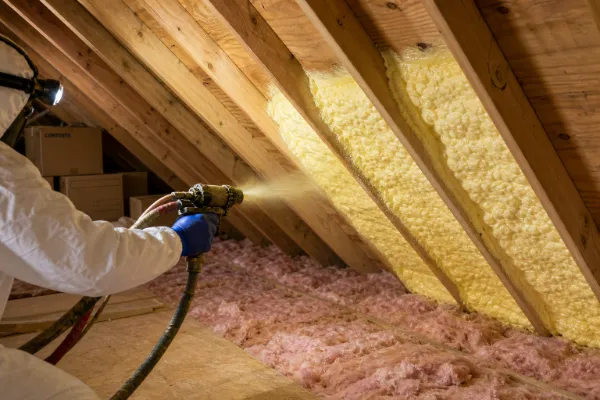
Windows, floors, and fixtures get masked and the spray zone sealed off. Certified crew, full PPE, ventilation running before the first pass.
Fiberglass comes out of rim joists and crawl walls so foam bonds to clean framing. Dry, bonded material elsewhere stays put.
Surfaces cleaned and dried, oversized gaps backed, substrate temperature verified. Foam only bonds right on properly prepped framing.
Closed-cell goes on in one-inch lifts so it cures hard without shrinking. Wet thickness is gauged on every surface as we go.
Overspray trimmed flush, final thickness photographed, masking removed. Re-entry is safe after the cure window we set together, usually the same evening.
The Grizzly 100% Guarantee
If the work isn't right, we make it right. That's the reputation we've built across the Front Range, and it's our only sales pitch.
04COST & SAVINGS
What Spray Foam Costs in Denver
Foam is priced per board foot, coverage area times inches of thickness, so an honest quote starts with a tape measure, not a phone script. Four inputs set your number, itemized in writing after a free assessment.
Board footage
Square feet of surface times inches of foam
Foam type
Closed-cell costs more per inch than open-cell
Access & prep
Crawl clearance, masking scope, substrate condition
Removal first
Old fiber out so foam bonds to clean framing
Three ways the net cost drops
Xcel Energy rebates
Air-sealing gains from foam frequently qualify for utility rebates. We flag every credit that applies in your written estimate.
Federal 25C tax credit
30% of qualifying insulation costs, up to $1,200 per year, under the Inflation Reduction Act.
Right-sized HVAC next time
A foamed envelope often lets your next furnace or AC be a size smaller, savings that keep paying after the foam pays for itself.
★ ★ ★ ★ ★
“Our vaulted great room was unusable every January — nowhere to add insulation. Grizzly foamed the roofline in a day and a half. It finally holds heat, and the wind stopped finding its way in.”
M
Melissa K.
Homeowner · Central Park, Denver · Closed-Cell Roofline Foam
05QUESTIONS
Spray Foam in Denver, Answered Straight
For the right assemblies, yes. Rim joists, crawl space walls, vaulted rooflines, and rooms over garages gain both R-value and an air barrier no fiber product can match. For wide-open attic floors, blown-in cellulose often reaches R-49 for less, and we quote both whenever both make sense.
Pricing runs per board foot: coverage area times thickness, adjusted for foam type, access, and prep. Rim-joist packages are the affordable entry point, whole-roofline projects cost more but transform comfort. Every number is itemized after an on-site measure, never quoted from a script.
Closed-cell (≈ R-6.5 to R-7 per inch) is rigid, moisture-resistant, and right for rim joists, crawl spaces, and rooflines in our climate. Open-cell (≈ R-3.8 per inch) is softer, quieter, and cost-effective inside interior walls. Most Denver projects we install call for closed-cell.
Yes, once cured. Certified installers apply foam in controlled lifts with ventilation running, and the home is safe to re-enter after the cure window, typically the same evening. Fully cured foam is inert and does not off-gas into your living space.
For the life of the structure. Closed-cell foam never settles, sags, or loses R-value the way fiber products do, and it never needs topping off. One correct application is a permanent upgrade to the building itself.
That is exactly what it is built for. Foam expands into the cracks and framing gaps that foothill gusts exploit and cures into a monolithic air barrier. Homeowners we foam near Ralston Valley tell us the whistling and cold-wall feeling disappear the first windy night.
06EVERY COMMUNITY WE SERVE
Spray Foam Insulation Near Denver
DenverDenverLakewoodEnglewoodCentennialLittletonGoldenGreenwood VillageBoulderLafayetteHighlands RanchLouisvilleErieEvergreenCastle Rock
07GET STARTED
Get the Straight Answer on Foam.
Free assessment. Board-foot pricing in writing. An honest call on where foam pays off and where it doesn’t. No pressure, ever.
- (303) 854-6221 · Mon–Sat 8 AM–5 PM · Sun by appointment
- info@grizzlyinsulationco.com, fast replies, usually same day
- 7140 Ivy St Unit B, Commerce City, CO 80022, 10 miles from Denver
Get Your Free Foam Quote
Takes 30 seconds. We reply within 24 hours.
Stop Heating
the Outdoors.
Tell us what’s going on with your home and we’ll map out the fix, warmer rooms, lower Xcel bills, and no critters in the walls.
- Free on-site assessment, no obligation
- 150+ Denver-area projects completed
- Insured, certified & 100% guaranteed
- Xcel rebate paperwork handled for you
(303) 854-6221
Get Your Free Quote in 30 Seconds
We reply within 24 hours, usually the same day. No pressure, no spam.
🔒 Your info stays private. No spam calls, ever.