
Lakewood Insulation › Spray Foam Insulation
Spray Foam Insulation in Lakewood, CO
Vaulted great rooms in Solterra, walk-outs on the Green Mountain slopes, brick ranches with two-inch wall cavities, foam solves the assemblies Lakewood’s architecture makes hard to insulate any other way.
- Free assembly-by-assembly assessment
- Priced per board foot, in writing
- Certified crew, controlled application
Your local crew, 25 minutes out
Commerce City HQ · all 7 Lakewood ZIPs
Where does foam beat everything else?
Foam earns its premium wherever space is tight and air movement is the enemy. Here’s how often each foam-first assembly shows up in the Lakewood homes we assess:
- Share of Lakewood assessments where foam is the right spec. Where fiber wins instead, we say so in the same visit.
TRUSTED PRODUCTS & PARTNERS
The Brands Behind Every Grizzly Install
We don’t install mystery material. Every Arvada project uses products from the industry’s most trusted manufacturers.








01THE PROBLEM
Some Assemblies Cannot Be Fixed With Fluff.
You cannot blow fourteen inches of cellulose into a two-inch brick cavity or a vaulted rafter bay. Half of Lakewood’s housing was built with exactly those constraints, and the west side adds Green Mountain’s wind on top. Closed-cell foam delivers R-6.5+ per inch and an air barrier in the same pass, which is why it exists.
AWalk-out basements bleeding at the band
Hillside lots in Solterra and Green Mountain Ranch mean walk-out basements, and walk-outs mean long, exposed rim bands. Two inches of closed-cell turns the leakiest framing in the house airtight in a single morning.
BCathedral ceilings with three inches to work with
Vaulted great rooms trade insulation depth for drama. Foam at the roofline returns double the R-value per inch, letting a three-inch rafter bay perform like a code attic without touching the ceiling below.
CBrick walls that were never insulated at all
Morse Park and Belmar brick ranches often have completely empty wall cavities too shallow for dense-pack to reach code. Injection and cavity foam bring those walls into this century without disturbing a single brick.
DChinooks that find every crack on the slope
When gusts pour off Green Mountain, fibrous insulation filters the wind, foam stops it. West-facing walls and roof edges foamed tight are the difference between hearing the storm and feeling it.
02THE FIX
Closed-Cell or Open-Cell? Match the Foam to the Job.
Two chemistries, two jobs. We spec by assembly and tell you plainly when blown-in fiber is the smarter spend instead.
| Closed-Cell FoamThe Lakewood workhorse | Open-Cell FoamThe sound & budget option | |
|---|---|---|
| How it works | R-6.5–R-7 per inch, rigid, moisture-resistant, adds structural stiffness | R-3.8 per inch, expands 100x, excellent at filling odd cavities and quieting rooms |
| Best for | Rim bands, walk-out framing, vaulted rooflines, shallow brick cavities | Interior walls, media rooms, sound control between floors |
| Install time | ✓ Half-day for most rim bands | 1–2 days for whole-envelope work |
| Cost per R-value | ✓ Higher per inch, highest R per inch | Lower cost, generous expansion |
| Air sealing | ✓ Air and vapor barrier in one | ✓ Strong air seal, vapor-open |
| Pest deterrence | ✓ Seals rodent entries solid | , Fills nesting voids completely |
| Eco profile | ✓ HFO low-GWP blowing agents | , Water-blown formulas available |
Our verdict: the default for hillside walk-outs, vaults, and brick-ranch walls across Lakewood. When fiber wins instead: a wide-open attic floor is still cellulose territory. See attic insulation in Lakewood. | ||
03WHAT TO EXPECT
A Controlled Chemical Process, Run by Certified Hands.
What a Lakewood foam project looks like from the homeowner side:
The spray zone gets isolated, surfaces masked, and negative ventilation established. Nothing gets sprayed until the containment passes our checklist.
Old batts come off rim bands and crawl walls so foam bonds to structure, not to loose fiber. Sound material outside the spray zone stays.
Foam chemistry is unforgiving: substrate temperature and moisture get metered before the rig starts, because adhesion failures are always prep failures.
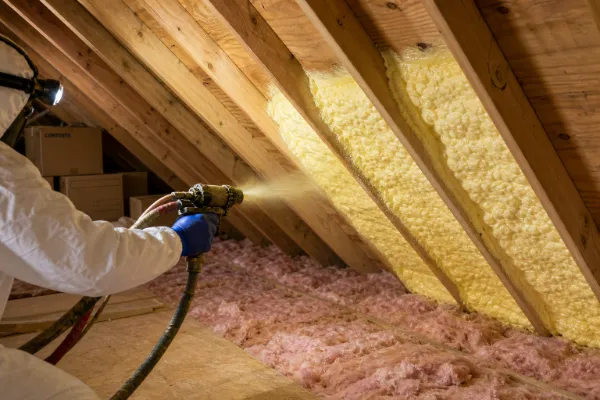
Closed-cell is applied in one-inch lifts that cure fully between passes, gauged wet for thickness on every surface. Slow is smooth; smooth is permanent.
Overspray trimmed, thickness documented in photos, masking out the door. You are back in the space after the cure window, typically that evening.
The Grizzly 100% Guarantee
If the work isn't right, we make it right. That's the reputation we've built across the Front Range, and it's our only sales pitch.
04COST & SAVINGS
What Spray Foam Costs in Lakewood
Foam pricing is geometry: surface area times thickness, adjusted for chemistry and access. The number comes off a tape measure at your free assessment, itemized per assembly.
Surface geometry
Board feet: area times specified inches
Chemistry
Closed-cell premium vs open-cell economy
Access difficulty
Crawl heights, vault pitches, hillside band runs
Prep & stripping
Old material off before foam goes on
Three ways the net cost drops
Xcel Energy rebates
The air-sealing performance of foam frequently qualifies projects for utility rebates, itemized in your estimate.
Federal 25C tax credit
30% of qualifying insulation costs, up to $1,200 per year, under the Inflation Reduction Act.
A permanent line item
Foam never settles or sags. One correct application is the last time that assembly appears on your to-do list.
★ ★ ★ ★ ★
"The vaulted ceiling in our Solterra great room made winter miserable, and two companies told us nothing could be done. Grizzly foamed the roofline in a day and a half. It is now the warmest room in the house, wind or no wind."
A
Aaron V.
Homeowner · Solterra, Lakewood · Closed-Cell Roofline Foam
05QUESTIONS
Spray Foam in Lakewood, Answered Straight
The rim band, especially on walk-out foundations, then crawl space walls, vaulted rooflines, and rooms over garages. These assemblies gain both R-value and an air barrier that no fiber product can provide, and they are exactly where hillside and mid-century Lakewood homes lose the most.
By the board foot: surface area times thickness, adjusted for closed-cell versus open-cell, access, and prep. A rim-band package is a modest ticket; a vaulted roofline transforms a room and costs accordingly. You get per-assembly line items after an on-site measure.
Often, yes. Many Morse Park and Belmar brick homes have shallow, empty cavities that dense-pack cannot bring to code. Injection foam fills them completely through small, patched openings, no brick disturbed, and the walls stop radiating cold.
With certified installers, yes. The zone is contained and ventilated, application happens in controlled lifts, and re-entry follows a defined cure window, usually the same evening. Cured foam is chemically inert; the safety story is entirely about correct process, which is why certification matters.
It is the single best answer to it. Wind pressure drives air through every gap in fibrous insulation; foam cures into a monolithic barrier the gusts cannot penetrate. West-slope homeowners tell us the cold-wall feeling disappears the first chinook after installation.
The life of the building. It does not settle, compress, or degrade like fiber products, and it never needs replacement or topping off. Combined with its structural and moisture benefits, it is the closest thing insulation has to a permanent upgrade.
06EVERY COMMUNITY WE SERVE
Spray Foam Insulation Near Lakewood
DenverArvadaLakewoodEnglewoodCentennialLittletonGoldenGreenwood VillageBoulderLafayetteHighlands RanchLouisvilleErieEvergreenCastle Rock
07GET STARTED
Insulate the Rooms Everyone Said Were Hopeless.
Free assembly-by-assembly assessment. Honest guidance on where foam pays and where fiber wins. Board-foot pricing in writing.
- (303) 854-6221 · Mon–Sat 8 AM–5 PM · Sun by appointment
- info@grizzlyinsulationco.com, fast replies, usually same day
- 7140 Ivy St Unit B, Commerce City, CO 80022, 10 miles from Arvada
Get Your Foam Assessment
Takes 30 seconds. We reply within 24 hours.
Stop Heating
the Outdoors.
Tell us what’s going on with your home and we’ll map out the fix, warmer rooms, lower Xcel bills, and no critters in the walls.
- Free on-site assessment, no obligation
- 150+ Denver-area projects completed
- Insured, certified & 100% guaranteed
- Xcel rebate paperwork handled for you
(303) 854-6221
Get Your Free Quote in 30 Seconds
We reply within 24 hours, usually the same day. No pressure, no spam.
🔒 Your info stays private. No spam calls, ever.